


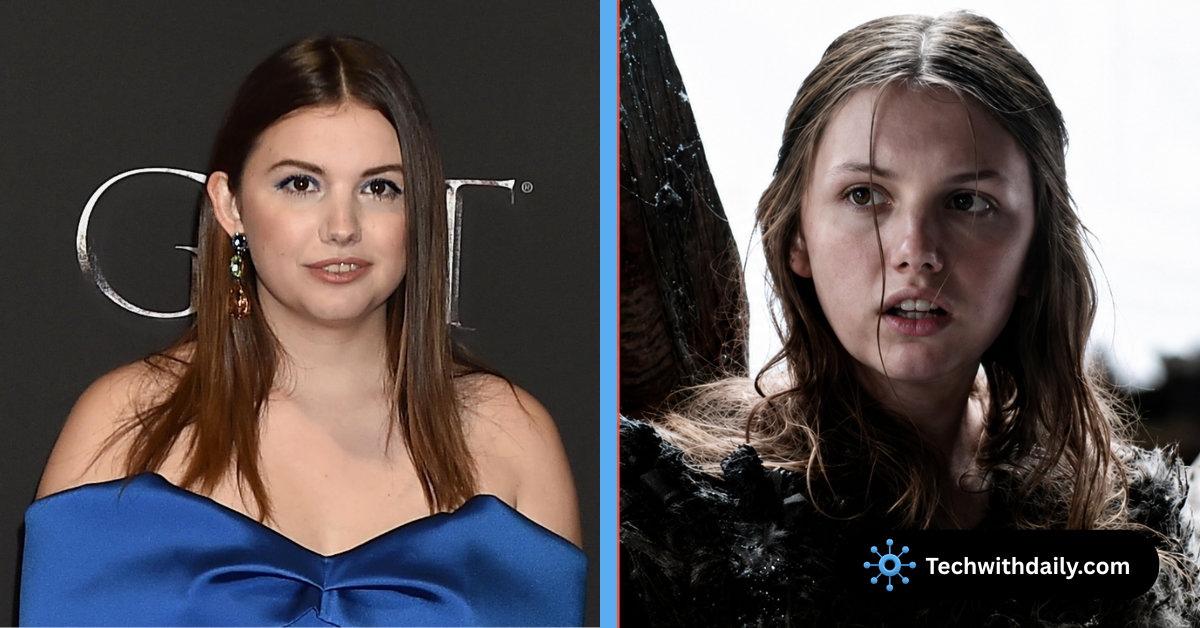
Hannah Murray spent more than a decade playing some of British and American television’s most memorable characters, from troubled teenager Cassie in Skins to Gilly in Game of Thrones. She built her career on a willingness to take on emotionally raw, difficult roles, earning critical acclaim along the way even in projects far outside the mainstream spotlight. Then, in 2026, she stepped forward with a very different kind of story: her own.
Here’s everything to know about her career, her most famous roles, and the personal journey that led her away from acting and into a new chapter as an author.
| Quick Facts | Details |
|---|---|
| Full Name | Tegan Lauren-Hannah Murray |
| Date of Birth | July 1, 1989 |
| Birthplace | Bristol, England |
| Nationality | British |
| Education | Queens’ College, Cambridge (English); University of East Anglia (Creative Writing) |
| Known For | Cassie in Skins, Gilly in Game of Thrones |
| Career Status | Retired from acting |
| Current Work | Author |
| Notable Book | “The Make-Believe: A Memoir of Magic and Madness” (2026) |
| Awards | Sundance Special Jury Prize, Tribeca Best Actress |
Who Is Hannah Murray?
Hannah Murray is a retired English actress best known for two very different but equally iconic roles: Cassie Ainsworth in the British teen drama Skins, and Gilly in HBO’s Game of Thrones. Over a career spanning more than a decade, she built a reputation for taking on emotionally demanding, complicated characters, both on screen and on stage.
Murray started acting as a teenager and quickly became known for her ability to portray vulnerability convincingly, a skill she carried from her breakout role as a struggling teen with an eating disorder in Skins through to award-winning performances in independent films years later. Her work consistently drew praise from critics, even in projects that didn’t reach a mass audience, and she developed a reputation among casting directors as an actress who fully committed to difficult, uncomfortable material.
In recent years, Murray has stepped away from acting entirely. In 2026, she released her first book, a memoir detailing a mental health crisis she experienced after becoming involved with a wellness group she has since described as a cult, marking a major shift from her acting career toward writing and public advocacy around mental health awareness.
Early Life and Education
Hannah Murray was born on July 1, 1989, in Bristol, England. Her parents both worked at the University of Bristol, her father as a professor and her mother as a research technician, giving her an academically minded upbringing in a city known for its arts and culture scene.
As a teenager, Murray became involved with the Bristol Old Vic Young Company, a respected youth theater program, where she developed her interest in acting. She also attended North Bristol Post 16 Centre for her further education, balancing her growing passion for performance with her academic studies.
At age sixteen, Murray auditioned for a new Channel 4 teen drama called Skins, mainly viewing it as useful practice for a future acting career rather than expecting it to become a defining role. She was cast almost immediately, launching a career that would take her far beyond what she originally anticipated from what she thought would be a low-stakes audition.
Breakthrough Role in Skins
Murray’s role as Cassie Ainsworth in Skins became one of the most talked-about performances in British teen television. The character, a fragile, dreamlike teenager struggling with an eating disorder, resonated deeply with young viewers and critics alike, helping define the show’s raw, unfiltered approach to depicting adolescence.
She played Cassie for the first two seasons of the show, from 2007 to 2008, before the series moved on to a new generation of characters, a common format for the show. Her performance earned her a nomination for a Golden Nymph Award for Outstanding Actress in a Drama Series, an early sign of the critical recognition that would follow her throughout her career.
Murray returned to the role in 2013 for a special anniversary episode, giving longtime fans a chance to revisit the character years later. By then, Cassie had already become one of the defining characters of British teen drama, and Murray’s original performance continued to be remembered as one of the show’s most emotionally affecting.
University Years and Stage Work
In 2008, at the height of her early fame from Skins, Murray chose to step back from acting to attend Queens’ College, Cambridge, where she earned a Bachelor of Arts degree in English. This decision to prioritize her education over immediately capitalizing on her television fame reflected a level of long-term thinking that would continue to define her career choices.
While at Cambridge, and in the years following, Murray also built a body of stage work, including her West End debut in Polly Stenham’s play “That Face” in 2008, and a later performance in the off-West End production “Martine” in 2014, which earned her a nomination for an Off West End Award for Best Female Performance. Her stage work gave her the chance to stretch beyond the screen roles that had made her famous, working in a format that demanded a different kind of discipline and immediacy.
This period of her career showed a deliberate balance between screen fame and serious dramatic training, a combination that gave her a reputation among casting directors and critics as a genuinely skilled actress, not simply a former teen drama star coasting on name recognition. Colleagues and directors who worked with her during this stretch often noted her willingness to take creative risks on projects with far less visibility than her television work, a pattern that continued throughout her career.
Rise to International Fame with Game of Thrones
In 2012, Murray joined the cast of HBO’s Game of Thrones as Gilly, a young woman living under the protection of Samwell Tarly, played by John Bradley. The role introduced Murray to a massive global audience, far larger than anything she had reached through her earlier British television and stage work.
Murray played Gilly for seven of the show’s eight seasons, watching her character grow from someone defined largely by hardship and fear into a more confident, capable presence by the series’ end. Her performance, along with the rest of the ensemble cast, earned three Screen Actors Guild Award nominations for Outstanding Performance by an Ensemble in a Drama Series.
Game of Thrones became one of the most-watched television series in history, and Murray’s role in it significantly expanded her career opportunities, opening doors to film projects with major directors that may not have been available to her otherwise. Playing Gilly required a different kind of range than her earlier work, moving away from the raw contemporary realism of Skins into a sprawling fantasy epic, and critics generally credited her with grounding the character in genuine emotional stakes even amid the show’s larger political drama.
Film Career and Award-Winning Performances
Alongside her television work, Murray built a respected film career defined by challenging, often difficult roles. In 2014, she starred in “God Help the Girl,” a musical drama written and directed by Stuart Murdoch of the band Belle and Sebastian, which won a Special Jury Prize at the Sundance Film Festival. The role allowed her to showcase a lighter, more musical side of her range compared to the heavier dramatic work she’d become known for.
In 2015, she took on the lead role in “Bridgend,” a Danish-produced drama exploring a real-life cluster of youth suicides in a Welsh town. The role earned her the Best Actress award at the Tribeca Film Festival, cementing her reputation as an actress willing to take on emotionally intense, socially significant material that many performers her age tended to avoid.
Her film career continued with roles in Kathryn Bigelow’s critically acclaimed 2017 drama “Detroit,” based on the Algiers Motel incident during the 1967 riots, and in 2018’s “Charlie Says,” where she played Leslie “Lulu” Van Houten, a former member of the Manson Family. Both performances were praised by critics and further established her as one of her generation’s more fearless dramatic actresses, someone consistently drawn to real, difficult stories rather than lighter commercial fare.
Stepping Away From Acting
In the years following Game of Thrones, Murray gradually moved away from acting, and by the mid-2020s, she had confirmed that she had retired from the profession entirely. Her decision came after a period of significant personal upheaval that she has since chosen to share publicly through her writing.
According to her own account, in 2017, while filming “Detroit” in the United States, Murray began struggling with her mental health. She has described the emotional toll of repeatedly portraying a traumatic assault scene, combined with the broader pressures of fame and a demanding acting career, as factors that left her searching for ways to cope.
It was during this vulnerable period that she was introduced to a wellness practitioner she calls “Grace” in her memoir, someone she met through a personal trainer on set. What began as informal “energy healing” sessions gradually pulled her deeper into a group she has since publicly described as a cult.
The Wellness Group and Mental Health Crisis
Over time, Murray became increasingly involved with the organization, paying to attend a series of classes with titles like “Ritual Master Novice” and “Ritual Master Apprentice.” Eventually, she was invited to a five-day intensive course at a London hotel led by the group’s leader, whom she has described as charismatic but has chosen not to name publicly.
During that course, running on very little sleep, Murray has said she began experiencing racing thoughts, seeing symbols and hidden meanings everywhere, and eventually hearing the group leader’s voice in her head. What followed was a full psychotic break, an experience severe enough that she was sectioned under the UK’s Mental Health Act and hospitalized for treatment.
Murray was later diagnosed with bipolar disorder, a diagnosis she has said brought her a sense of relief and understanding after an incredibly frightening and disorienting period. In interviews, she has spoken candidly about how the experience reshaped her relationship with wellness culture entirely, saying that even mild practices like meditation or yoga can now feel distressing to her.
Life After Acting: Becoming an Author
Rather than returning to acting, Murray redirected her energy toward writing. She studied Creative Writing at the University of East Anglia, building on the English degree she had earned years earlier at Cambridge, and began working on what would become her first book.
In January 2026, it was announced that Murray’s memoir, titled “The Make-Believe: A Memoir of Magic and Madness,” would be released on June 23, 2026, through Penguin Random House. The book chronicles her path from the pressures of Hollywood fame into the wellness group, her psychotic break, and her long road toward reclaiming her sense of self afterward. Rather than framing the story purely as a Hollywood cautionary tale, Murray uses much of the book to explore how genuine searching for meaning and connection can leave anyone, regardless of education or background, vulnerable to manipulation.
The memoir received strong early praise from critics and fellow authors, with reviewers describing it as unflinching, well-written, and notable for resisting easy narratives about victimhood or recovery. Publications including The Guardian, Vogue, and The Telegraph highlighted the book’s emotional honesty and literary quality, treating it as a serious work of nonfiction rather than simply a celebrity tell-all. Several reviewers specifically praised her refusal to sensationalize her own story, noting that the book focuses more on understanding than on shock value.
Authors and fellow memoirists who read early copies also praised the writing itself, drawing comparisons to other notable accounts of cult involvement and mental health recovery. The consistent theme across reviews was that Murray approached deeply painful material with genuine literary skill, rather than relying solely on her existing fame to sell the book.
Public Advocacy and Speaking Out
Since announcing her memoir, Murray has given a series of candid interviews discussing her experience, aiming to challenge assumptions about who is vulnerable to manipulation by cult-like groups. She has pushed back against the idea that intelligence or education make someone immune to this kind of exploitation, pointing out that she considered herself well-educated and level-headed before everything unfolded.
In these interviews, she has emphasized the importance of empathy over judgment when discussing people who become involved in manipulative groups, arguing that dismissing victims as simply foolish prevents a real understanding of how these situations develop. She has also spoken about how deeply she avoids anything connected to wellness culture now, from crystal shops to guided meditation, given how closely tied those practices became to her breakdown.
Rather than retreating from public life after such a difficult experience, Murray has chosen to use her platform, built originally through acting, to speak openly about mental health, manipulation, and recovery, a markedly different kind of public role than the one she held during her years on Skins and Game of Thrones.
Frequently Asked Questions
What is Hannah Murray best known for? She is best known for playing Cassie Ainsworth in Skins and Gilly in Game of Thrones.
Has Hannah Murray retired from acting? Yes, as of 2026, Murray has confirmed she has retired from acting and is now focused on writing.
What is Hannah Murray’s memoir about? Her memoir, “The Make-Believe: A Memoir of Magic and Madness,” details her experience joining a wellness group, a subsequent mental health crisis, and her bipolar disorder diagnosis.
Where did Hannah Murray study? She studied English at Queens’ College, Cambridge, and later studied Creative Writing at the University of East Anglia.
What awards has Hannah Murray won? She won a Special Jury Prize at Sundance for “God Help the Girl” and the Best Actress award at Tribeca for “Bridgend.”
Conclusion
Hannah Murray’s career took her from a teenage breakout role in Skins to global recognition on Game of Thrones, built on a genuine talent for portraying vulnerable, complicated characters. What makes her story especially striking is the honesty she’s brought to her own life after acting, choosing to write openly about a mental health crisis rather than keep it private. Her memoir marks not an ending, but a new chapter, one built on the same emotional depth and fearlessness that defined her acting career all along.